
Shelby County Parole vs Probation
Illinois uses several terms that can sound alike. Probation is a sentence or court order supervised through the local court system. In Shelby County, the county probation office handles that work. Parole applies most directly to older indeterminate sentences and certain statutory review cases. Many people serving modern determinate prison sentences leave an IDOC institution on mandatory supervised release, often shortened to MSR. The Illinois Prisoner Review Board sets state supervision conditions, while IDOC administers community supervision.
The distinction matters because no single public search covers every kind of Shelby County supervision. A county probation question begins with the criminal docket and the Shelby County Probation office. A state parole or MSR question begins with the IDOC Individual in Custody Search. The PRB calendar and decisions address certain hearings and violations, but they are not a complete name-search list of everyone under state supervision.
| Supervision | How it begins | Best verification route |
|---|---|---|
| Probation | Shelby County court order | County criminal docket and probation office |
| MSR | Release after a modern IDOC prison term | IDOC status, location, and discharge fields |
| Parole | Older indeterminate sentence or a statutory review path | IDOC record plus relevant PRB result |
- Discharge
- The end of the sentence or supervision obligation shown by the responsible agency.
- Absconder
- A person alleged to be absent from supervision, not a person who has completed it.
- Revocation
- A formal process that can change or end community supervision after an alleged violation.
Check Shelby County Post-Release Supervision
First identify the custody path. A person who only served time in Shelby County Jail will not gain an IDOC record merely from that county stay. A person sentenced to state prison should be checked in IDOC. Someone placed on probation should be traced through the Shelby County criminal case and local office. Match at least two identifiers, since the same name can belong to people in other Illinois counties or to one of the many Shelby Counties in other states.
- Open the Shelby criminal docket or IDOC search based on the sentence and prior custodian.
- For IDOC, search by IDOC number when known, or use last name or birthdate and then compare the full record.
- Read Offender Status and Location before relying on Last Paroled Date or Projected Discharge Date.
- For probation, inspect the court docket for the probation order, later petitions, warrants, or a discharge order.
- Contact the responsible office and ask what public confirmation is available when the online record is unclear.
An IDOC location or status that refers to parole or community supervision shows that the person is out of the prison facility, but it does not establish full discharge. Likewise, a past parole date records an event rather than the end of all obligations. The broader Shelby County released-inmate search explains how to reconcile the custody record with the court file.
Shelby County Probation Contacts
Shelby County publishes a named probation team and direct office routes, but it does not publish a public name-search database. The official page names Chief Probation Officer Heather Wade, officers Angela Durbin and Ryann Ambrose, and assistant Brenda Richardson. Contact the office about the public information available for a specific court case. Do not assume that office staff can disclose every supervision detail.
Shelby County Probation301 E. Main Street
Shelbyville, IL 62565
Phone: 217-774-2412
Fax: 217-774-2533
Email: probation@shelbycounty-il.gov
The official Shelby County Probation page shows the local team, Drug Court route, and published contact details.
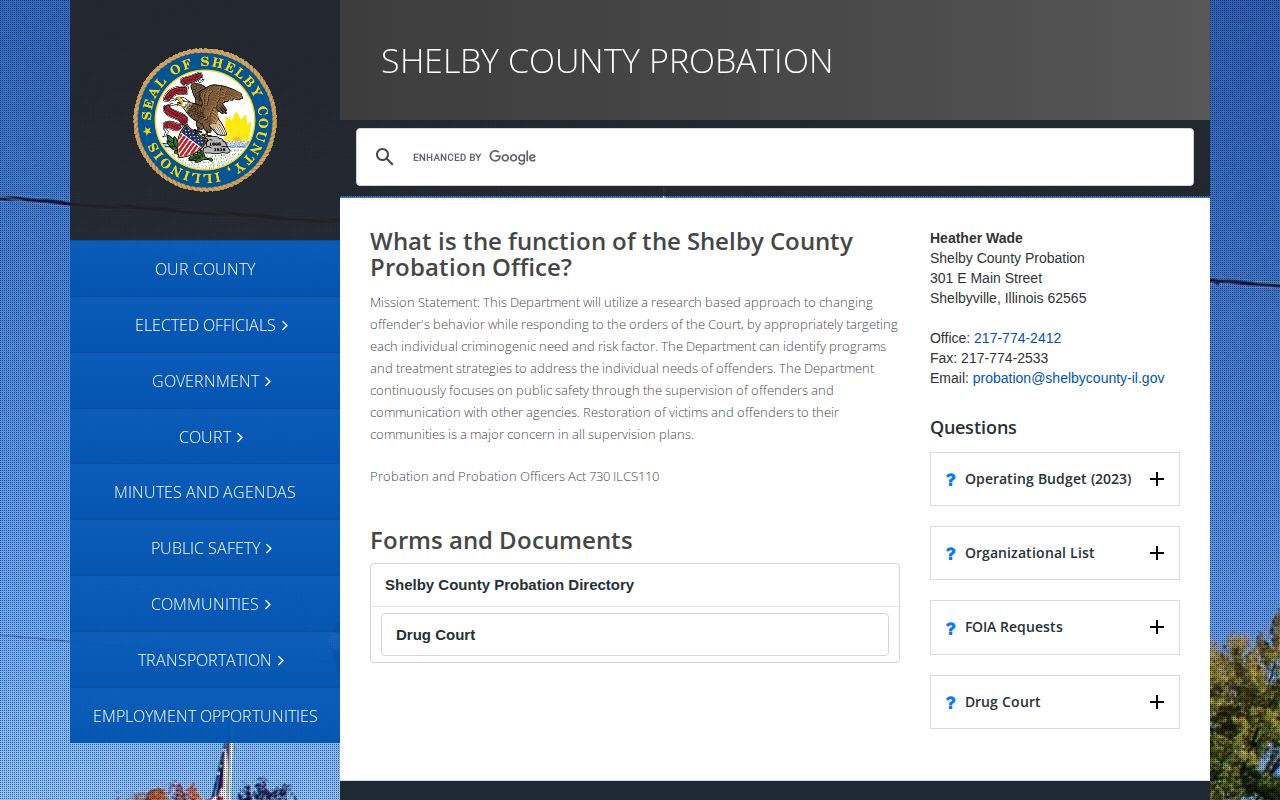
This county source is the correct starting point for local probation questions, while IDOC remains the source for state parole and MSR status.
The county directory also identifies probation1@shelbycounty-il.gov as a records or FOIA contact. Court records themselves follow judicial access rules rather than executive-branch FOIA. A request for the probation order, petition, or discharge order should therefore be routed through the Circuit Clerk when it is part of the court file.
Shelby County Supervision Violations
Conditions are rules attached to release or probation. Their exact terms belong to the person's order and supervising agency, so a general web result should not be used to guess them. If IDOC lists an absconder status, that means an alleged failure to remain in contact or comply with supervision. It is not proof of discharge. The IDOC wanted-fugitives page is an alert path, not a normal list of released people.
State violations follow the PRB process. Preliminary review asks whether probable cause exists to proceed. A final revocation hearing addresses the alleged violation and its disposition. The Board posts monthly revocation results under 730 ILCS 5/3-3-9(d), but those results concern supervision events after release and do not establish the original prison exit time. County probation violations are more likely to appear as petitions, warrants, hearing orders, or dispositions in the Shelby criminal docket.
Illinois VINE can report participating custody changes, but it is not a supervision ledger. A VINE alert should be read as the source agency's event and checked against IDOC, the court, or the county office if the result could mean return to custody or transfer.
When Shelby County Supervision Ends
Release and discharge are separate points. Leaving an IDOC prison can begin MSR or parole, while discharge ends the sentence or supervision obligation shown in the state record. Read Offender Status, Location, Projected Discharge Date, and each sentence row's “SENTENCE DISCHARGED? YES/NO” field together. A projected date may change and may display as undetermined. Written verification can be requested from IDOC Public Information when a website record is not enough.
For probation, look for a court order ending the term or otherwise disposing of the case. The mere passage of an expected date is not the same as a filed discharge order. A warrant, pending violation, new order, or other case event may affect the record. Record the exact source wording and the date checked.
Shelby County Drug Court Route
Shelby County Drug Court is a locally named, court-supervised program for qualifying high-risk people with substance dependence. The probation office connects the program with treatment and community resources. Its existence does not mean that any named person participates. For navigation, the probation office uses 217-774-2412 and Shelby County Community Services uses 217-774-1400.
Drug Court is distinct from IDOC parole and MSR. A court docket and the local probation office are the sound sources for a county program question. State supervision remains an IDOC and PRB matter.
Shelby County Parole Hearing Records
The Illinois Prisoner Review Board operations hub publishes monthly hearing calendars for institutional panels, final signing reviews, en banc sessions, and other proceedings. Most modern determinate prison releases do not hinge on a discretionary grant-or-deny vote. The calendars are most relevant when the case involves indeterminate parole, youthful review, revocation, early MSR discharge, medical release, or another listed PRB function.
Indeterminate cases generally stem from the pre-February 1978 framework. Eligible people may return for review at intervals of one to five years. The current en banc results can show a grant, denial, or continuation, yet the page is not a complete release ledger. Verify actual release and supervision through IDOC. PRB Operations can be reached at PRB.OPERATIONS@ILLINOIS.GOV or 217-782-7273.
The youthful-parole statute, 730 ILCS 5/5-4.5-115, contains offense, age, sentencing-date, and exception rules. Its applicable version must be checked for the specific case rather than reduced to one universal date formula.
Correcting Shelby County IDOC Records
Release alone does not remove conviction information from IDOC. The IDOC FAQ describes a narrow correction or removal path that depends on proper paperwork from the committing court. After reversal and remand, for example, certified not-guilty documents may be required. Other stated outcomes receive individual review.
A former individual sends the qualifying court documents and a cover letter to IDOC Public Information. That process corrects the corrections record when the legal basis exists. It is different from verifying parole, MSR, probation, or discharge, and it should not be treated as automatic after release.
Checked July 16, 2026. Agency pages and status fields can change, so preserve the wording and retrieval date used for any conclusion.
Use the committing court's case number and certified papers when asking IDOC to correct a record. Keep the cover letter and note the date sent. A correction request should identify the precise outcome and sentence row at issue, not ask for routine deletion merely because confinement ended.