
Shelby Projected and Actual Dates
A projected release date is a calculation based on the sentence information, custody credit, and legal rules then in the file. An actual release date records an event that already occurred. Illinois IDOC does not place every idea under one generic tentative-release label. Its public record can show “Projected Parole Date,” “Projected Discharge Date,” and “Last Paroled Date,” and each answers a different question.
Scheduled is not actual
A future date is an estimate or calculated milestone. Confirm an actual Shelby County exit through the responsible jail or corrections record.
Projected Parole Date concerns a calculated prison-release milestone. Projected Discharge Date concerns the expected end of the sentence or supervision framework. Last Paroled Date is historical. Always read those fields with Offender Status and Location. A person can be outside prison on mandatory supervised release while the sentence remains active.
A Shelby County pretrial detainee is different. No fixed sentence is yet being calculated. A court order, change in conditions, dismissal, another warrant, or hold can control the outcome. Even a court order may precede the jail's physical processing, so the docket is not an exact exit clock.
Find a Shelby Release Date
First determine whether the person is in Shelby County Jail, has transferred to an IDOC institution, or belongs to another system. Applying the IDOC calculator to a county stay produces a false answer.
- Match the person with a birth date, booking or case number, or IDOC number rather than name alone.
- For county custody, check the Shelby court docket for the order, sentence, holds, and custody credit.
- Ask Shelby County Jail whether the person remains physically present and what disposition is recorded.
- For state prison, use the official IDOC search by last name, IDOC number, or birthdate.
- Read Offender Status, Location, Projected Parole Date, Last Paroled Date, and Projected Discharge Date together.
- Confirm the result with the jail or IDOC when another hold, transfer, or final discharge matters.
The Shelby County release-record guide provides the broader route for obtaining the county custody-event record. A jail request can seek the booking/release sheet, recorded release date and time, disposition, and receiving agency if a transfer occurred.
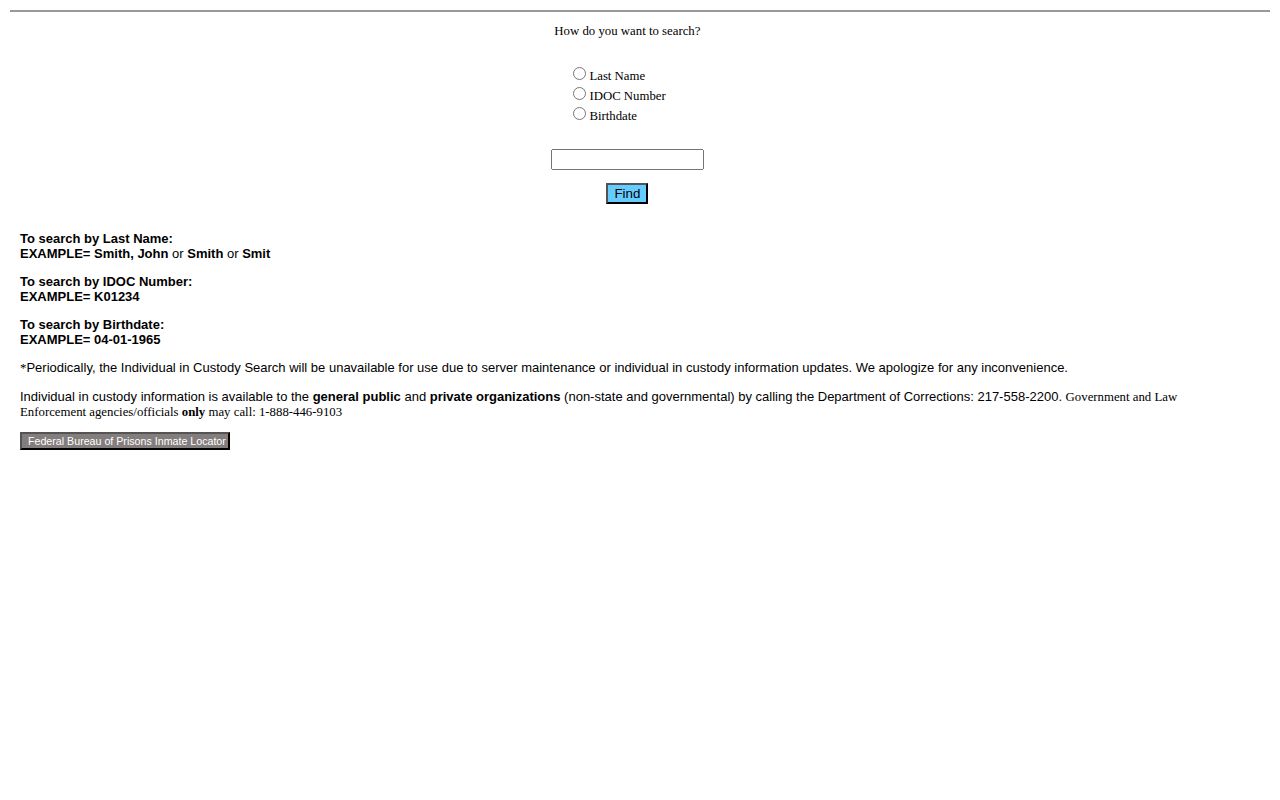
The IDOC Individual in Custody Search is the official landing point for state-sentence results.
IDOC Shelby Release Calculations
IDOC directive 01.07.400 describes determinate sentence calculations. It distinguishes projected release from mandatory release and accounts for consecutive or concurrent terms, custody credit, writs, court orders, and statutory restrictions. Its controls include review by two records staff. That review process helps explain why a date should come from the official record rather than informal arithmetic.
Statutory sentence credit can be revoked or restored in the projected-release calculation. Mandatory release can change through loss of time, including absence from supervision. A later court order or corrected mittimus can also change the inputs. Thus a date can move even when the original sentence length stated in court remains the same.
IDOC directive 01.07.420 addresses earned program sentence credit. When an award is approved, staff recalculate the projected date on the Sentence Calculation Worksheet, record the award in Offender 360, file the support, and notify the individual. The described calculation begins with the custody date and sentence, applies statutory or good-conduct credits, adjusts lost or restored time, and subtracts awarded earned-program credit. For an indeterminate-law case with a Board-set date, the Prisoner Review Board date controls the starting projected date.
Illinois Credit Rules for Shelby Cases
The state-prison credit statute is 730 ILCS 5/3-6-3. Its rules turn on the exact offense and the date that law applies. It authorizes credit categories for qualifying programming, service, and rule compliance, while also imposing exclusions and agency discretion.
Serious-offense provisions can require service of 85 percent, 75 percent, or 100 percent, depending on the offense and applicable version. The familiar limit of 4.5 credit days per month yields roughly 85 percent service for designated cases. It is wrong to state that every Illinois prisoner serves 85 percent. It is also wrong to assume every person receives program credit. IDOC's guidance says people convicted of offenses that require 100 or 85 percent service are generally not eligible for programming credit, even though they may take part in programs.
The statute also provides for reasonable notice, at least 14 days before the earlier release, to specified State's Attorneys when an earned-credit grant advances a date. That is an intergovernmental notice rule. It does not give the public a guaranteed 14-day release notice, and it does not turn a projection into an appointment time.
Use the applicable statute
Offense, sentence date, credit eligibility, discipline, and court paperwork can all change the IDOC result. General percentage rules are not enough.
Shelby County Jail Good Time
Shelby County's distinctive calculation issue is that a county jail sentence does not use the IDOC projected-date formula. The County Jail Good Behavior Allowance Act, 730 ILCS 130/3, supplies a separate rule for eligible fixed-term county prisoners.
The Act provides one day of good-behavior allowance for each qualifying day served and for qualifying presentence custody caused by inability to meet pretrial-release conditions. More than 12 hours of a fractional day counts as a full day. For an eligible sentence, that allowance can shorten counted confinement substantially, sometimes to roughly half the counted time. That is an illustration of the statute's effect, not a promise for a person held at Shelby County Jail.
Exclusions include categories involving inflicted physical harm, reductions below a mandatory minimum, county impact incarceration, listed sex offenses, specified periodic-imprisonment settings, and civil contempt. Discipline and judicial authorization can also matter. The jail and court record are therefore needed to determine eligibility and the actual credit entered.
Pretrial detention should not be folded into this estimate. It is not a fixed county sentence merely because the person has spent days in the Shelby jail. Court conditions, warrants, case events, or transfer can end or extend that custody without following the sentence-credit formula.
What Changes Shelby Release Dates
A projected date moves when an official input changes or when another authority prevents release to the community. The following distinctions help identify which office can explain the change.
| Factor | Possible effect | Best source |
|---|---|---|
| Credit awarded | May advance an IDOC projected date if the person and award qualify. | IDOC sentence record |
| Credit revoked or restored | Can move the projected calculation later or earlier. | IDOC records and directive controls |
| County good behavior | May reduce an eligible fixed Shelby jail term under separate law. | Jail record and court file |
| Concurrent or consecutive terms | Changes how multiple sentences combine. | Mittimus, docket, and IDOC calculation |
| Court order or corrected paperwork | Can alter sentence, custody credit, or authority for release. | Shelby Circuit Clerk and records staff |
| Warrant, detainer, or receiving agency | May turn a planned community exit into continued custody or transfer. | Jail event and receiving authority |
| Supervision event | Absence, revocation, or Board action can affect custody and discharge timing. | IDOC and PRB records |
A future date also may not include the time needed for local processing. Conversely, an earned-credit award can produce an earlier date after notice and recalculation. Only the system that maintains the sentence worksheet can state the current official result.
Confirm a Shelby Release Event
For county custody, call Shelby County Jail at 217-774-3941 and ask whether the person is still physically present. If not, ask for the recorded disposition or receiving agency. Use a focused written request when the exact time or transfer document matters. The Shelby docket can explain the legal order but should be reconciled with the physical custody record.
For state custody, recheck IDOC status and location near the date. “Parole” or mandatory supervised release can mean the person left prison but remains under state supervision. “SENTENCE DISCHARGED? YES” addresses a different milestone. PRB material may explain a Board action for an eligible case, but most modern determinate releases are not all individual grant-or-deny parole decisions.
A Shelby County VINE check can add a pending custody-change alert. VINE is agency-fed and may lag, so use it as a cross-check rather than a substitute for the release sheet. Federal and ICE systems require their own locators and court or records paths.
Document the exact date label, retrieval time, status, location, and source. If the sources disagree, ask whether the unresolved fact is the legal authorization, physical exit, supervision start, transfer, or final discharge. Each can carry a valid but different date.